Website Development Sri Lanka: The Complete 2026 Guide for SMEs
Sri Lanka’s digital economy now accounts for 4.37% of GDP — and with 12.4 million internet users (53.6% of the population) actively browsing the web, having a professional website is no longer optional for Sri Lankan businesses. It is the foundation of every lead, every sale, and every credibility check a customer performs before picking up the phone.
Yet most Sri Lankan SMEs still operate with outdated websites, no mobile optimisation, or no website at all. The result? They are invisible to the 29.3 million mobile connections actively searching for local services every day.
This guide covers everything a Sri Lankan business owner needs to know about website development in 2026 — from how much it costs in LKR, how long it takes, which platform to choose, and how to pick the right agency. Lakion has spent 14+ years building websites for businesses across Gampaha, Colombo, Kandy, and beyond. Here is what actually works.
How Much Does Website Development Cost in Sri Lanka?
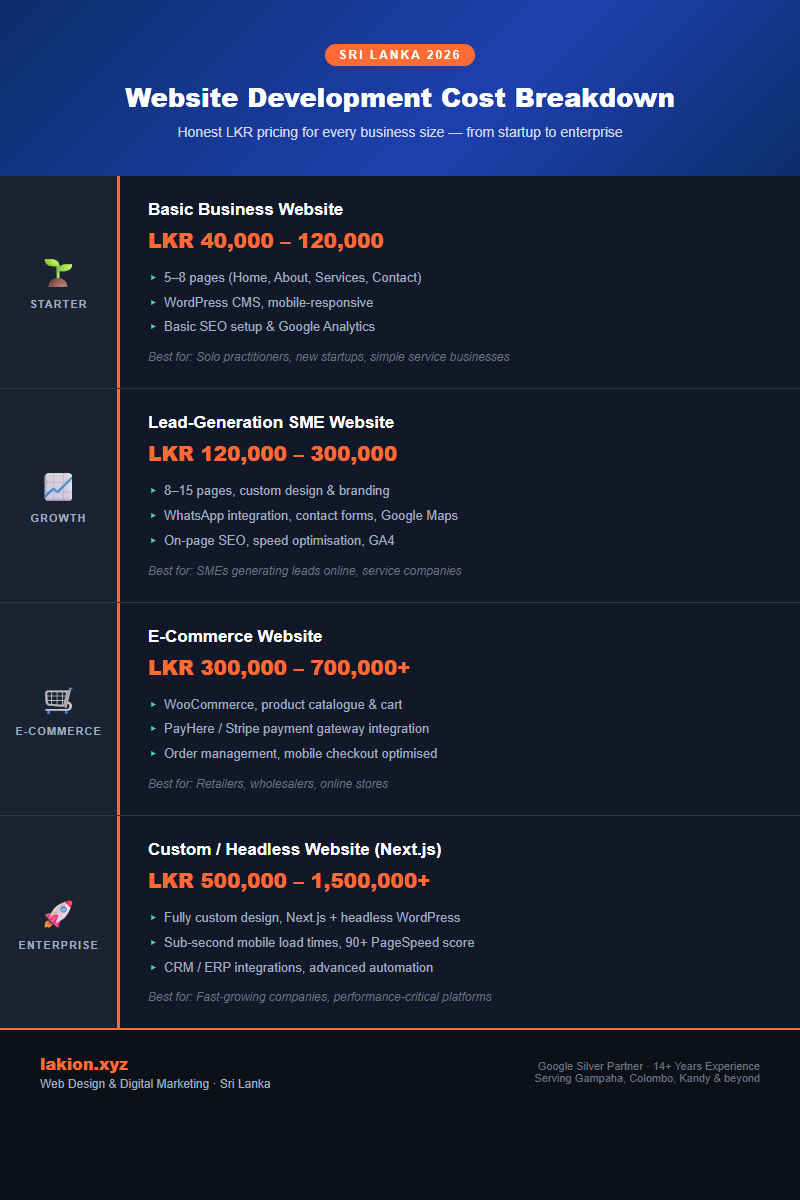
Pricing is the first question every business owner asks — and the most misunderstood. There is no single “right” answer because website cost depends heavily on what you actually need. Here is an honest breakdown based on real agency pricing in the Sri Lankan market.
Basic Business Website (Brochure Site)
- LKR 40,000 – 120,000
- 5–8 pages: Home, About, Services, Contact, Blog
- WordPress or similar CMS
- Mobile-responsive design
- Basic SEO setup
- Suitable for: small service businesses, solo practitioners, startups
Small Business Website (Lead-Generation Focused)
- LKR 120,000 – 300,000
- 8–15 pages with custom design
- Contact forms, WhatsApp integration, Google Maps embed
- On-page SEO, Google Analytics setup
- Speed-optimised for mobile
- Suitable for: SMEs wanting to generate enquiries online
E-Commerce Website (WooCommerce or Custom)
- LKR 300,000 – 700,000+
- Product catalogue, cart, payment gateway (PayHere, Stripe)
- Inventory management, order notifications
- Mobile checkout optimised
- Suitable for: retailers, wholesalers, online stores
Custom / Enterprise Website (Next.js or Headless)
- LKR 500,000 – 1,500,000+
- Fully custom design and architecture
- Headless CMS (WordPress + Next.js), sub-second load times
- Advanced integrations (CRM, ERP, automation)
- Suitable for: growing companies needing performance and scalability
Ongoing costs to budget for: Domain (LKR 1,500–5,000/year for .lk), hosting (LKR 6,000–30,000/year), SSL, maintenance, and content updates add roughly LKR 30,000–120,000 per year depending on your setup.
Note: Be cautious of quotes under LKR 25,000 for a full business website. At that price point, you are typically getting a generic template with no SEO setup, no performance optimisation, and minimal support after launch — which costs more to fix later than it saved upfront.
How Long Does Website Development Take in Sri Lanka?
Timeline depends on complexity, content readiness, and how quickly you provide feedback. Here is a realistic breakdown:
| Website Type | Typical Timeline |
|---|---|
| Basic 5-page brochure site | 1–2 weeks |
| E-commerce site (WooCommerce) | 4–8 weeks |
|---|---|
| Custom / headless build (Next.js) | 6–12 weeks |
The single biggest cause of delays in Sri Lankan web projects is content. If you do not have your text, photos, and logo ready when development begins, timelines stretch — sometimes by weeks. Start gathering your content before you engage an agency.
WordPress vs Custom Development: What Should Sri Lankan Businesses Choose?
This is the question Lakion gets asked most often. The honest answer: it depends on your goals, team, and budget. Here is the breakdown.
WordPress — Best for Most SMEs
Are you searching for a reliable WordPress designer Sri Lanka? WordPress powers over 43% of all websites globally. For most Sri Lankan SMEs, it is the practical choice:
- Lower upfront cost — themes and plugins reduce custom coding time
- Easy for non-technical teams — your marketing team can update content without a developer
- Plugin ecosystem — SEO (Rank Math), forms, e-commerce (WooCommerce) all built and battle-tested
- Widely supported — easy to find developers and support in Sri Lanka
When to choose WordPress: You need to be live quickly, your content team will manage updates, you have a clear budget ceiling under LKR 300,000.
Next.js (Custom / Headless) — Best for Growth-Focused Businesses
Next.js is a React-based framework that can be up to 10x faster than a comparable WordPress site. Lakion uses Next.js for clients who need performance as a competitive advantage:
- Core Web Vitals scores of 90+ are consistently achievable — critical for Google rankings
- No plugin vulnerabilities — the attack surface is dramatically smaller than WordPress
- Scales without limits — handle traffic spikes from campaigns without site slowdowns
- Headless architecture — you get WordPress’s easy content editor with Next.js’s performance
When to choose Next.js: You are investing in SEO for the long term, you run paid ad campaigns and need fast landing pages, or you are building a product (not just a website).
Lakion’s own website (lakion.xyz) runs on Next.js with a headless WordPress CMS. The result: consistently sub-second load times, even on mobile connections in Sri Lanka.
💡 Expert Insight — Lakion, Google Silver Partner
With over 14 years of experience building digital solutions for Sri Lankan and New Zealand businesses, Lakion has seen both extremes: clients who over-invested in custom development they did not need, and clients who went cheap and rebuilt their website twice in three years. The best investment for most Sri Lankan SMEs is a well-structured WordPress site built for SEO from day one, with a clear upgrade path to headless when you outgrow it. As a certified Google Silver Partner (ID: 4886119785), Lakion applies international performance standards to every local project — because your website competes globally the moment it goes live.
What to Look for When Choosing a Web Development Agency in Sri Lanka
The Sri Lankan web development market has hundreds of providers — from solo freelancers to full-service agencies. Here is how to evaluate them.
1. Portfolio with Real Results
Ask to see live websites the agency has built, not just screenshots. Check those sites on your phone — are they fast? Do they look professional on mobile? Can you verify the business is real?
2. EEAT and SEO Knowledge
A beautiful website that does not rank on Google is an expensive brochure. Ask the agency: “What SEO setup is included?” If they do not mention title tags, meta descriptions, schema markup, Core Web Vitals, and internal linking — keep looking.
3. Transparent Pricing
Reputable agencies provide itemised quotes. If you are getting a single “LKR X for a website” with no breakdown, ask for specifics: design, development, content, SEO setup, hosting, training.
4. Local Understanding
Whether you are searching for targeted web design Gampaha, a professional website designer in Colombo, or a hospitality site in Kandy, an agency with local clients understands the Sri Lankan buyer — what they search for, what they trust, and what makes them enquire. That local knowledge is worth more than it sounds.
5. Post-Launch Support
Your website will need updates. Ask what support is available after launch, what the response time is, and whether it is included or billed separately.
A Real Example: How a Gampaha SME Tripled Their Leads After a Rebuild
One of Lakion’s clients — a wholesale distribution business based in Gampaha — came to us with a six-year-old website that was not mobile-responsive, took over 8 seconds to load on mobile, and had zero on-page SEO.
After a full rebuild — mobile-first design, WordPress CMS, Rank Math SEO configuration, Google Analytics 4, and a structured internal linking strategy — the results within 90 days:
- 3x increase in monthly enquiries from organic search
- Page load time reduced from 8.3s to 1.9s on mobile (Google PageSpeed Insights)
- First-page Google ranking for their primary local keyword in under 60 days
The investment was in the LKR 150,000–200,000 range. The monthly lead value generated exceeded that within the first quarter.
This is not unusual. According to Google’s research on page speed, a 1-second delay in mobile load time can reduce conversions by up to 20%. For a Sri Lankan business getting 500 visitors a month, that is a tangible revenue impact.
Key Features Every Sri Lankan Business Website Needs in 2026
Based on what Lakion sees across client audits, these are the non-negotiables:
Mobile-First Design
Sri Lanka has 29.3 million active mobile connections — more than the total population. DataReportal 2025 reports that mobile internet is how most Sri Lankans access the web. Your site must load fast and look right on a 4G connection.
WhatsApp Integration
Sri Lankan customers prefer WhatsApp for initial enquiries. A WhatsApp click-to-chat button on every page (especially the homepage and contact page) significantly increases conversion rates from local traffic.
Sinhala / Tamil Language Support (Where Relevant)
If your target market includes customers outside Colombo, consider bilingual content. ICTA’s digital inclusion goals specifically target rural and semi-urban markets where English is a second language.
Google Business Profile Integration
Your website and Google Business Profile must be consistent — same business name, address, phone number (NAP). Inconsistencies hurt local search rankings. Embed your Google Maps location on the contact page.
SSL and Security
All websites must run on HTTPS. Google flags HTTP sites as “not secure” — a trust signal that kills conversions. Most reputable Sri Lankan hosts include SSL, but confirm this before signing up.
Schema Markup
Structured data (JSON-LD schema) tells Google exactly what your business is, what services you offer, and where you are located. It is not optional for competitive local SEO. At minimum, implement LocalBusiness and Organization schema.
How Website Development in Sri Lanka Has Changed in 2026
The Sri Lankan web development industry has matured significantly. According to the ICTA Digital Economy Blueprint, Sri Lanka is actively working to digitalise 750 SMEs, with Gampaha, Kandy, Kurunegala, and Colombo as priority zones. That government push is creating demand — and competition.
A few developments shaping the market in 2026:
- AI-assisted design tools have reduced the design phase by 30–40% for template-based sites, bringing costs down
- Core Web Vitals are now a confirmed Google ranking factor, making performance a business-critical investment
- Headless CMS architecture (WordPress + Next.js) is increasingly adopted by agencies targeting enterprise and growth clients
- Local hosting vs. international: Sri Lankan-hosted sites often have faster load times for local visitors — worth considering if your audience is primarily Sri Lankan
Frequently Asked Questions
How much does a website cost in Sri Lanka in 2026?
Website development in Sri Lanka typically costs between LKR 40,000 and LKR 700,000+ depending on complexity. A basic 5–8 page business website starts from around LKR 40,000–120,000. A full-featured SME website with lead generation, SEO setup, and mobile optimisation typically falls in the LKR 120,000–300,000 range. E-commerce and custom Next.js builds start from LKR 300,000 upward.
How long does it take to build a website in Sri Lanka?
A standard business website takes 3–5 weeks from briefing to launch. Simple 5-page brochure sites can be delivered in 1–2 weeks. E-commerce sites take 4–8 weeks. Custom or headless builds (Next.js) typically take 6–12 weeks. The main factor that extends timelines is content — having your text, images, and logo ready before development starts saves weeks.
Should I use WordPress or a custom website for my Sri Lankan business?
Most Sri Lankan SMEs are best served by WordPress — it is cost-effective, easy for non-technical teams to manage, and has a rich plugin ecosystem for SEO, forms, and e-commerce. If you are investing in long-term SEO, running ad campaigns, or building a high-traffic site, a Next.js headless build delivers significantly better performance and Google rankings over time.
What is the difference between web design and web development in Sri Lanka?
Web design focuses on the visual layout, user experience, and brand presentation. Web development is the technical build — coding the site, connecting the CMS, setting up databases, and ensuring it functions correctly. Most Sri Lankan agencies offer both together as a package. When evaluating providers, ask whether design and development are handled in-house or outsourced.
Do I need a .lk domain for my Sri Lankan business website?
A .lk domain (e.g. yourbusiness.lk) is not strictly required, but it signals local relevance to both Google and Sri Lankan customers. Domain registration through the LK Domain Registry costs approximately LKR 1,500–5,000 per year. If a .com is available with your brand name, that is also perfectly fine — especially if you have international customers.
How do I know if my website needs to be rebuilt or just updated?
If your site is over 4 years old, not mobile-responsive, loads in more than 3 seconds on mobile, or scores below 50 on Google PageSpeed Insights, a rebuild is almost certainly more cost-effective than patching. Lakion offers free website audits for Sri Lankan businesses — we will give you an honest assessment of whether to fix or rebuild.
Ready to Build a Website That Actually Grows Your Business?
Website development in Sri Lanka has never been more accessible — but the difference between a website that sits there and a website that generates leads every week comes down to strategy, SEO, and execution.
At Lakion, we build websites that rank on Google, load fast on Sri Lankan mobile connections, and are designed to convert visitors into enquiries. As a Google Silver Partner with 14+ years of experience across Gampaha, Colombo, and the wider Sri Lankan market, we bring both technical depth and local market knowledge to every project.
Explore our full range of web design and digital services, see examples of our work in our project portfolio, or get in touch to discuss your website project — no obligation, just a straight conversation about what will work for your business.